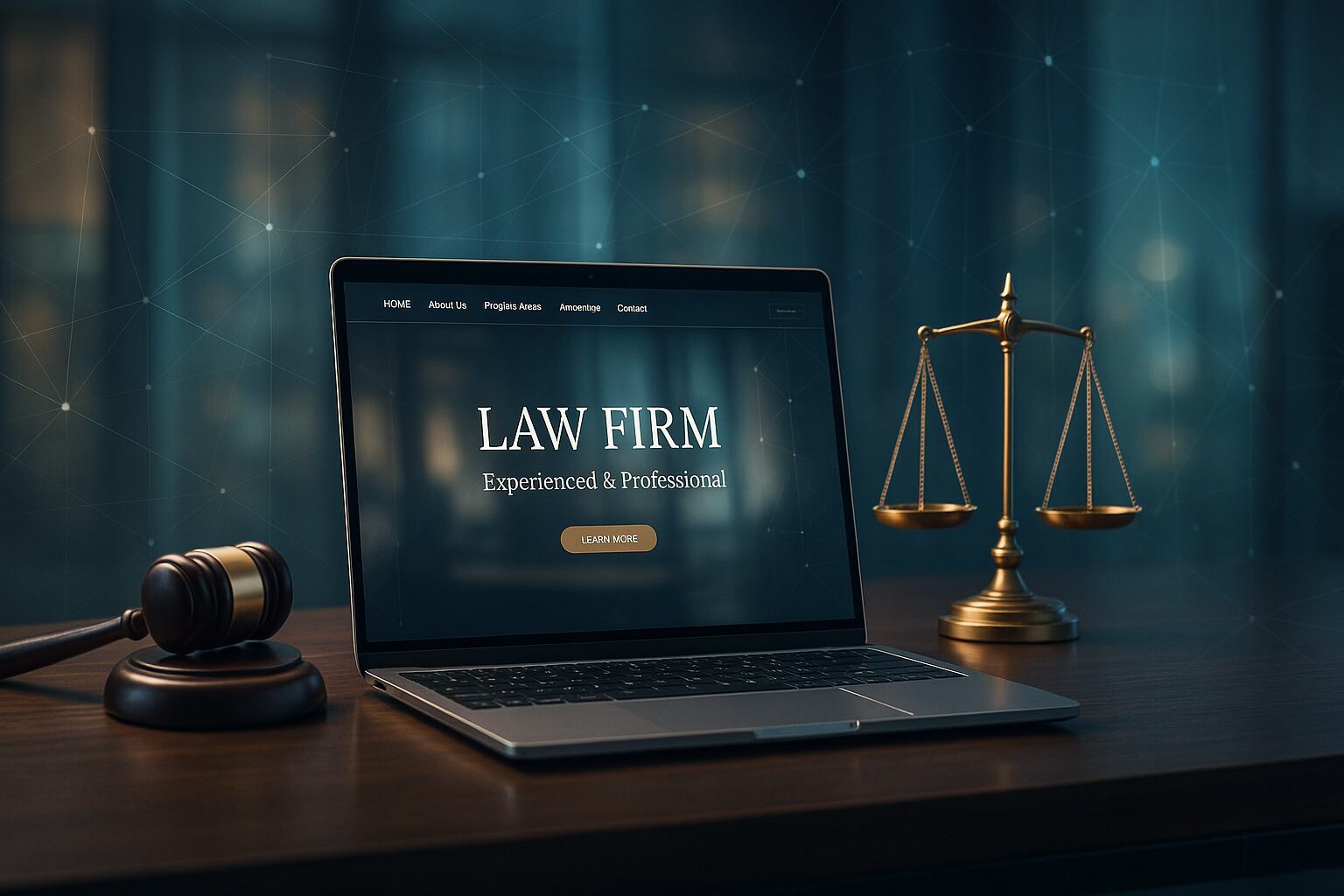
In the high-stakes world of legal marketing, your website is your 24/7 senior partner. It is the first place potential clients go to judge your competence, your credibility, and your capability to win their case.
The data is undeniable: 96% of people seeking legal advice start their search online, and 74% of potential clients visit a law firm’s website to take action—or leave for a competitor. In 2025, a brochure-style website is a liability. To dominate your market, your firm needs a high-performance digital asset that combines elite aesthetics, psychological trust triggers, and rigorous technical SEO.
This guide reveals the exact blueprint high-growth firms use to turn traffic into retainers. We will dismantle the common mistakes that get firms sued or ignored, and show you the Devbo standard for legal web design.
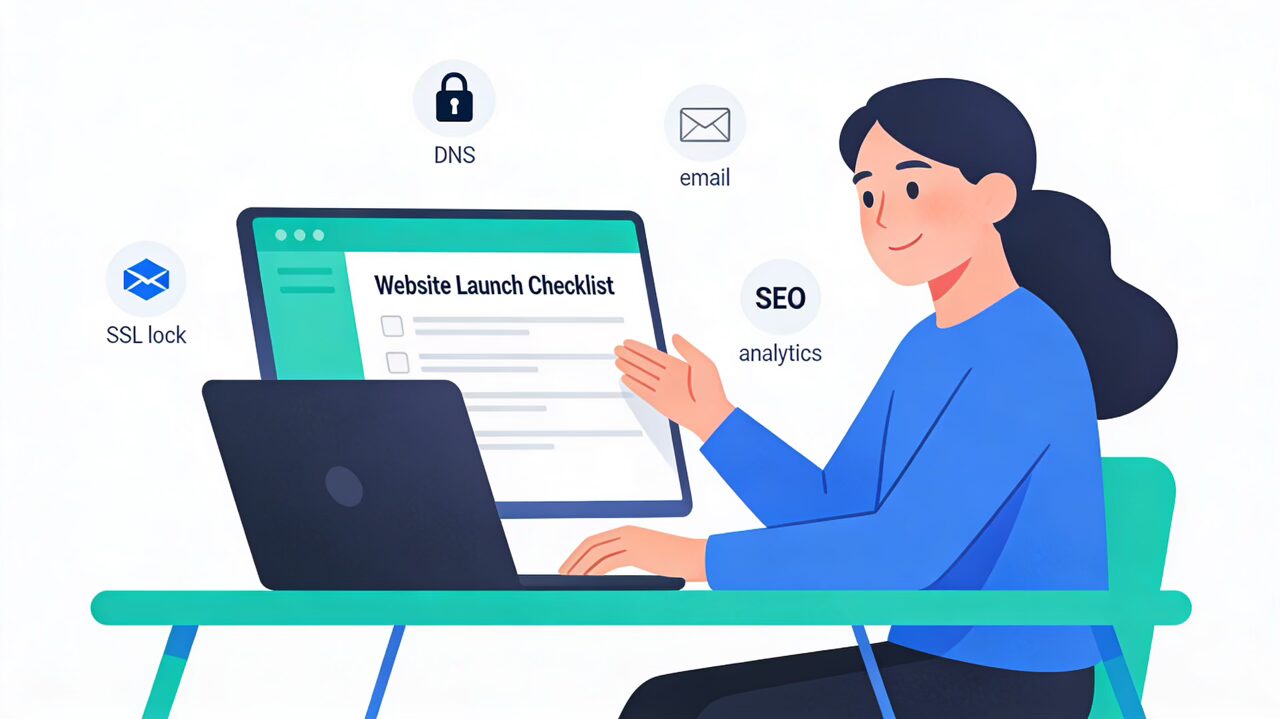
We follow an in-depth launch checklist to make sure our website launches go smoothly, if you’re interested in a professional website design and you don’t want to be in DIY hell anymore, get in touch with our team!
The 3-Second Verdict: Why Design is Dispositive
In a courtroom, you might get an hour to make an opening statement. Online, you get three seconds. Research from Stanford confirms that 75% of users admit to making judgments about a company’s credibility based on their website design.
For attorneys, this judgment is amplified. Clients are often anxious, in pain, or facing financial ruin. They are looking for one thing: competence.
If your site loads slowly, looks like a template from 2015, or is difficult to navigate on a phone, the subconscious verdict is immediate: “This firm is outdated, disorganized, and unlikely to win my case.”
The “Trust Triangle” of Legal Design
A high-converting law firm website must satisfy three psychological needs instantly:
- Authority: Do they look successful and respected?
- Empathy: Do they understand my specific problem?
- Clarity: Is it obvious how to hire them?
Anatomy of a High-Converting Law Firm Website
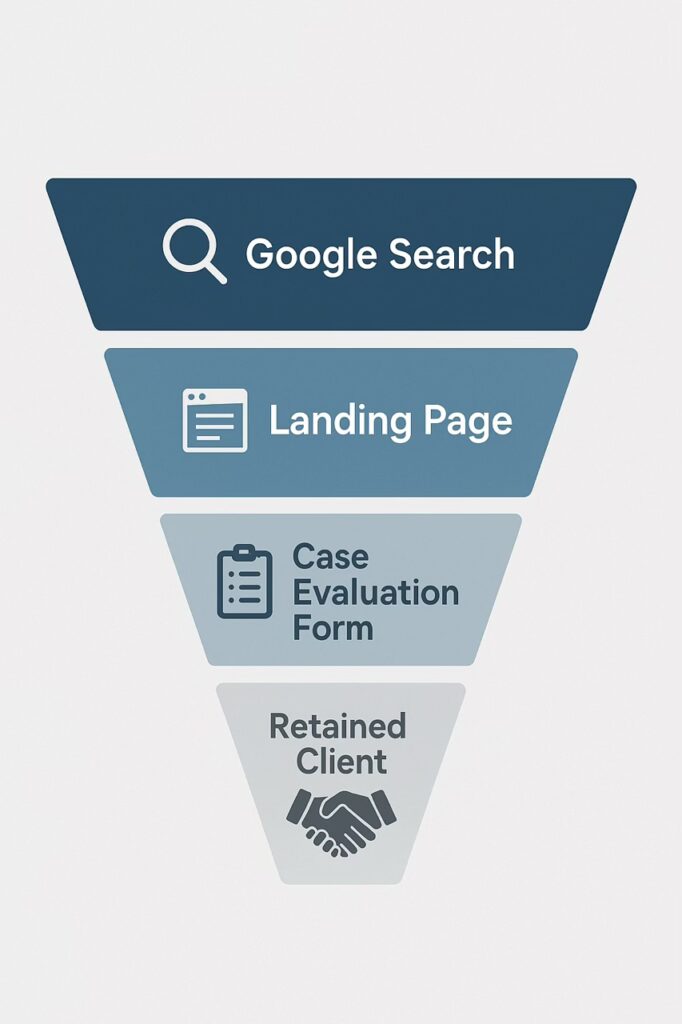
We have analyzed hundreds of top-ranking legal websites. The winners all share a specific architectural DNA designed to guide a visitor from “anxious searcher” to “retained client.”
A. The Hero Section: Your Opening Argument
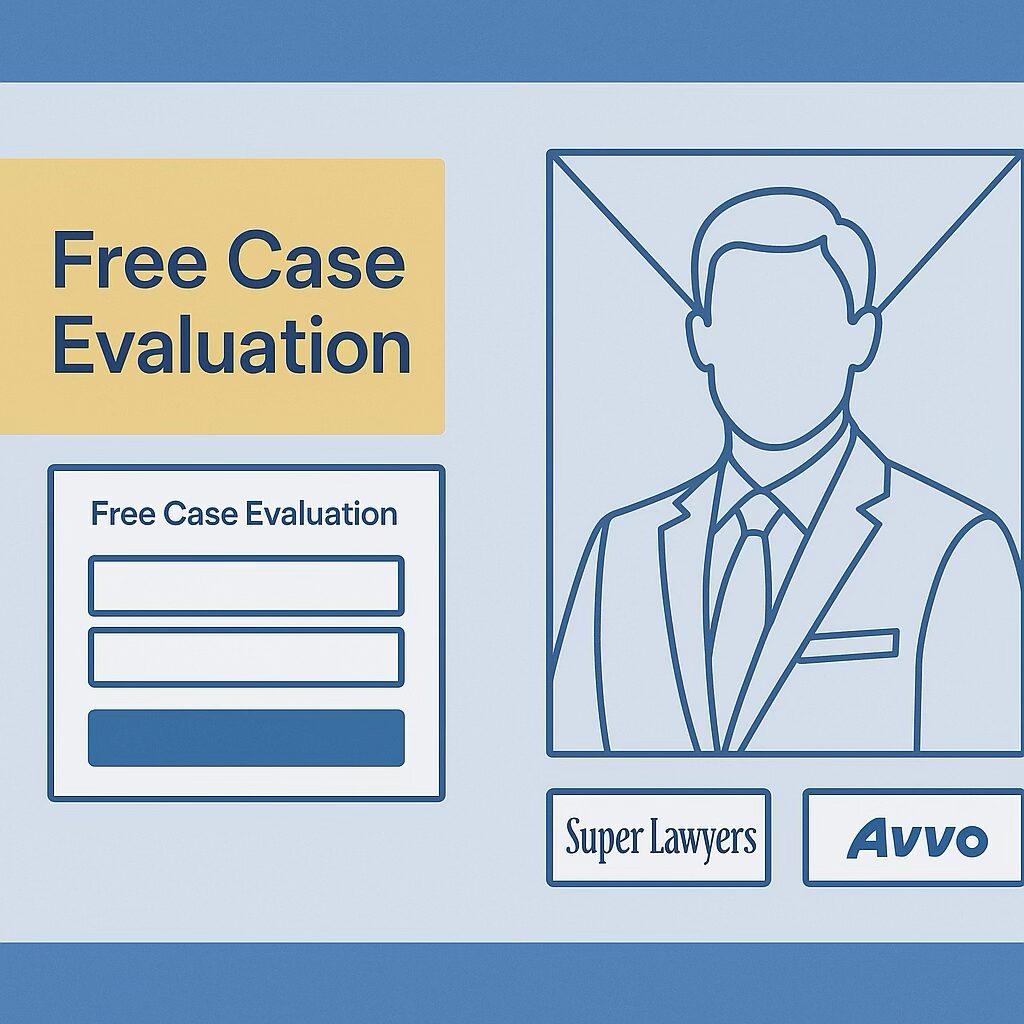
Above the fold (the part of the screen visible without scrolling), you must answer three questions:
- Who are you? (e.g., “Tampa’s Aggressive Personal Injury Attorneys”)
- What can you do for me? (e.g., “We Don’t Get Paid Unless You Win”)
- What do I do next? (e.g., “Free Case Evaluation” button)
Pro Tip: Avoid generic skylines. Use high-quality photography of your attorneys in action. Real faces build trust; stock photos of gavels build indifference.
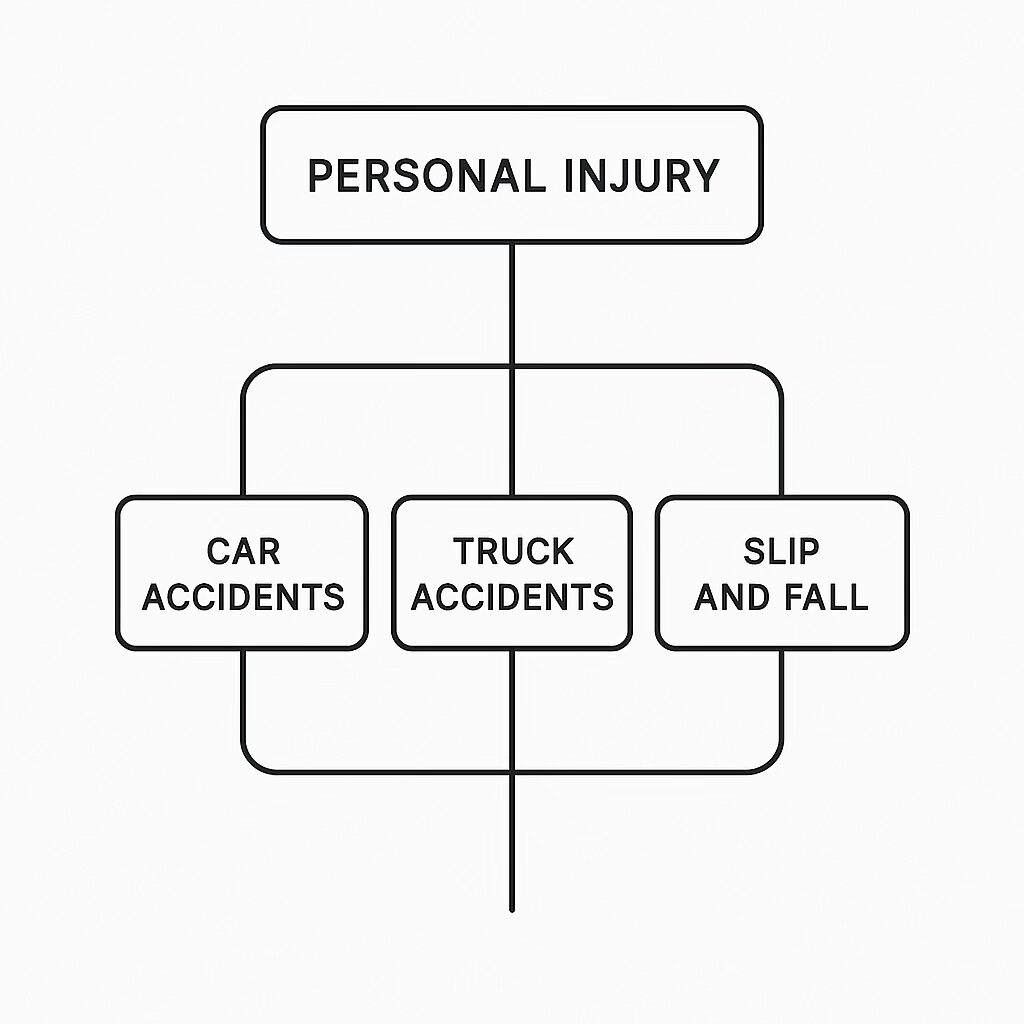
B. Practice Area “Silos”: The SEO Powerhouse
Most firms list their services in a simple bulleted list. This is a mistake.
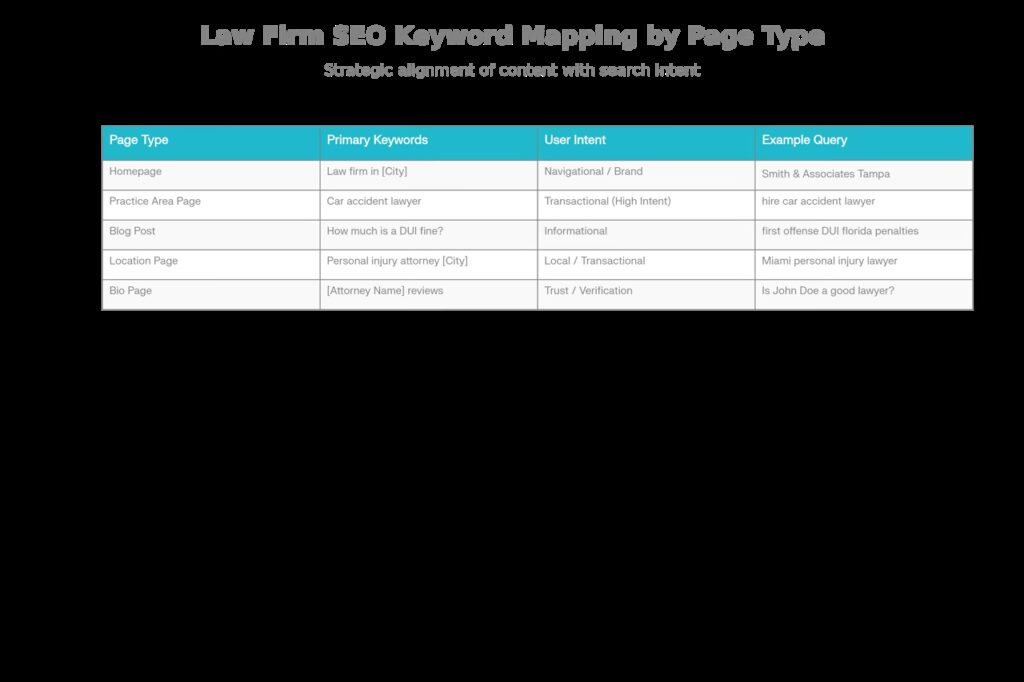
To rank for high-value terms like “Truck Accident Lawyer” or “Divorce Attorney for Business Owners,” you need dedicated landing pages for each specific case type.
This structure creates “Topic Silos” that signal expertise to Google. A generic “Services” page will never outrank a competitor’s 2,000-word deep dive into “Medical Malpractice.”
C. The “Thumb Zone”: Mobile-First Defense
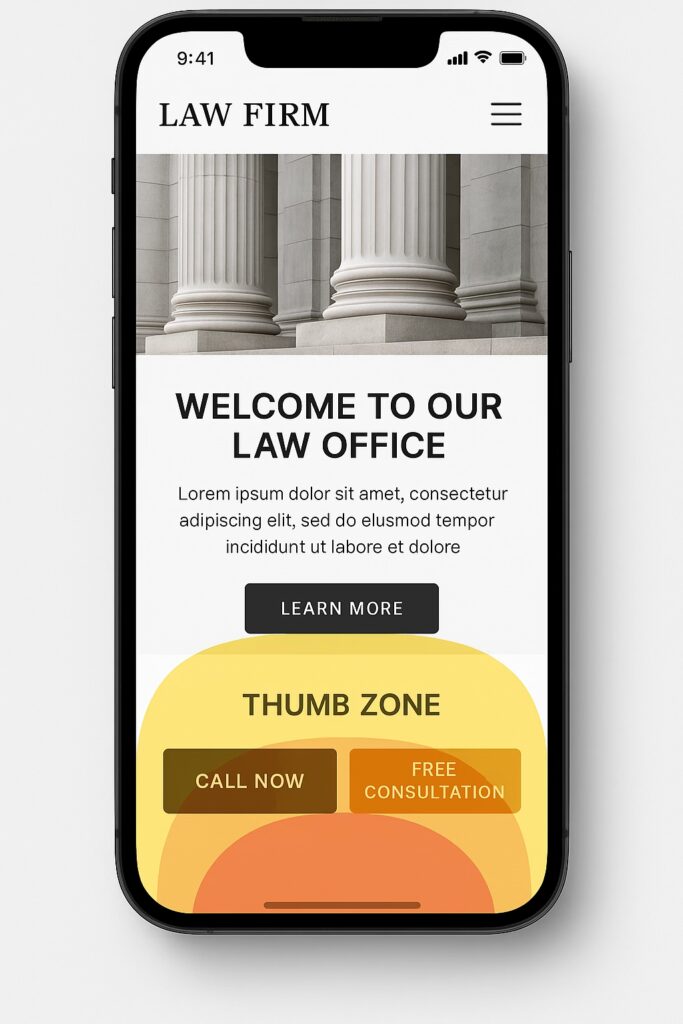
Over 60% of legal searches happen on mobile devices—often from a hospital bed, a police station, or a scene of an accident.
Your site must be thumb-friendly. The “Call Now” and “Free Consultation” buttons must be pinned to the bottom of the screen (the “sticky footer”), allowing users to contact you with a single tap without hunting for a phone number.
Trust Signals: Evidence Beyond Reasonable Doubt
In legal marketing, claiming you are the best is hearsay. Proving it is admissible evidence. Your website must strategically deploy “Trust Signals” to lower the client’s guard.
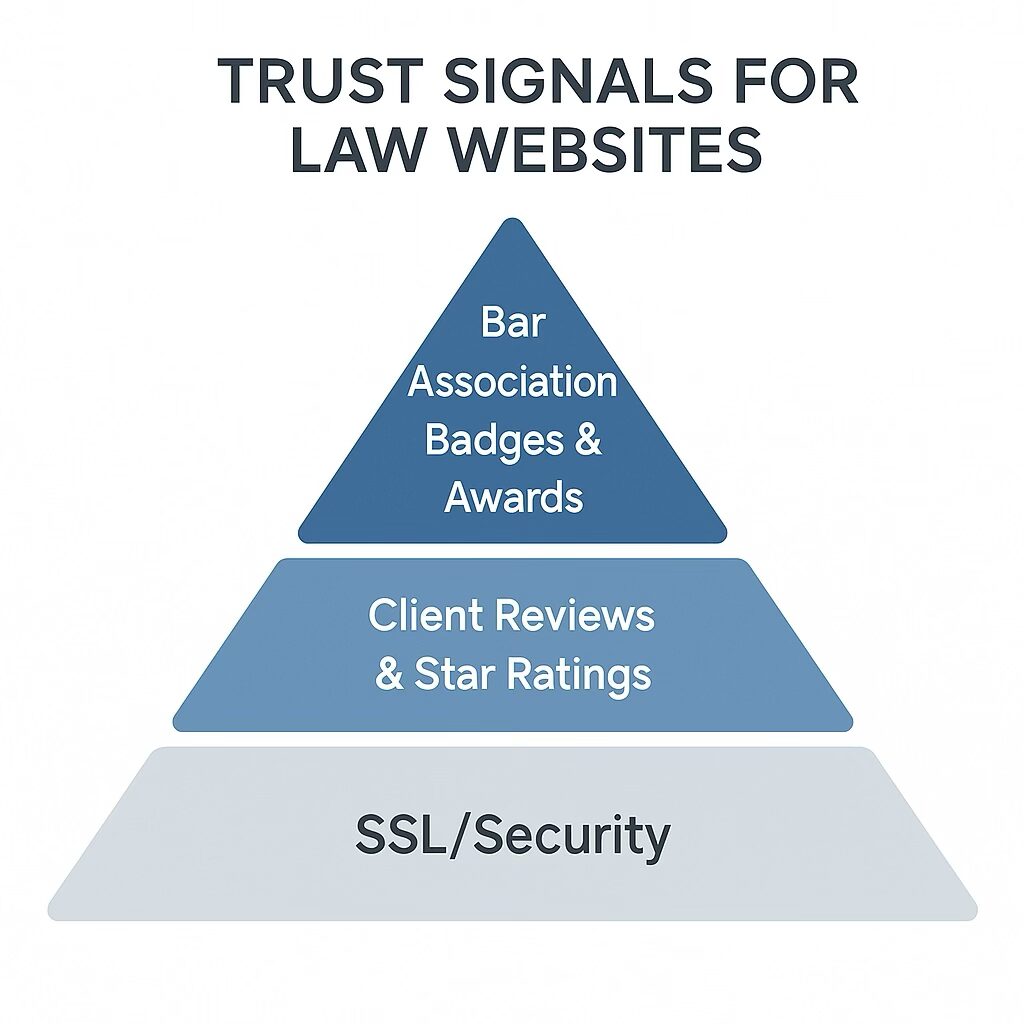
The Hierarchy of Trust
Not all badges are created equal. Prioritize them in this order:
- Hard Metrics: “Over $50 Million Recovered,” “30 Years in Practice,” “500+ 5-Star Reviews.”
- Third-Party Validation: Super Lawyers, Martindale-Hubbell AV Preeminent, Board Certifications.
- Social Proof: Video testimonials (the gold standard) and Google Reviews embedded directly on the site.
- Security: SSL certificates and “Secure Form” badges, especially for criminal defense forms where privacy is paramount.
Compliance Note: Always include the necessary disclaimers (e.g., “Past results do not guarantee future performance”) to comply with your state Bar Association’s advertising rules.
Technical SEO for Law Firms: The Discovery Phase
A beautiful website that no one sees is like a brilliant closing argument in an empty courtroom. SEO (Search Engine Optimization) is how we get the jury to show up.
Local SEO & The “Map Pack”
For 90% of law firms, the battle is local. You want to appear in the “Local Pack” (the map with 3 listings) when someone searches “Lawyer near me.”
- NAP Consistency: Your Name, Address, and Phone Number must be identical across your footer, Google Business Profile, Avvo, and Justia.
- Location Pages: If you have offices in Clearwater, St. Pete, and Tampa, you need a unique landing page optimized for each city.
Schema Markup: Speaking Google’s Language
We wrap your website’s code in LegalService Schema. This tells Google explicitly:
- “We are a PersonalInjuryAttorney” (not just a business)
- “Our price range is contingency”
- “These are our aggregate star ratings”
This code helps you win “Rich Snippets”—those expanded search results with star ratings and FAQs that get higher click-through rates.
Compliance & Ethics: Keeping Your License Safe
Digital marketing for attorneys is a regulated industry. A generic web designer might unknowingly violate Bar rules, leading to ethics complaints.
Devbo’s Compliance Checklist includes:
- No Unverifiable Claims: Avoid “The Best Lawyer in Florida” unless you are literally the only one. Use “Top-Rated” (if backed by ratings) instead.
- Dramatization Disclaimers: If you use actors in videos or photos, they must be labeled.
- Results Disclaimers: Every mention of a settlement or verdict must be accompanied by the standard disclaimer text visible on the same screen.
- ADA Compliance: Your site must be accessible to users with disabilities (screen readers, keyboard navigation). This is not just ethical; law firms are prime targets for ADA demand letters.
Common Mistakes to Strike from the Record
We see the same errors costing firms millions in lost fees.
Mistake #1: The “We Do Everything” Trap
“Jack of all trades, master of none” kills conversion. If you do Personal Injury AND Family Law AND Criminal Defense, you look desperate, not skilled.
Solution: If you practice multiple areas, use separate landing page silos that feel like distinct boutique firms, or split your brand into separate websites.
Mistake #2: Weak Calls to Action (CTAs)
“Contact Us” is weak. It implies effort.
Solution: Use benefit-driven CTAs: “Get Your Free Case Review,” “See What Your Case is Worth,” or “Speak to an Attorney in 5 Minutes.”
Mistake #3: Buried Contact Forms
Don’t make users click a “Contact” page to find a form. A lead capture form should be visible on every single page of the website, preferably in the sidebar or sticky footer.
The Devbo Approach: Building Legal Assets
At Devbo, we don’t just “design websites.” We build client acquisition engines.
Our Process:
- Discovery: We analyze your top 5 competitors to find their keyword gaps.
- Architecture: We map out a “Silo Structure” that positions you as the topical authority for your specific practice areas.
- Design: We create a custom aesthetic that commands respect—no templates, no cliché stock photos.
- Content: Our legal copywriters (JD-reviewed) write authoritative content that balances SEO with Bar compliance.
- Launch & Lead: We integrate your site with your CRM (Clio, MyCase, Salesforce) so every lead is tracked instantly.
Frequently Asked Questions (FAQ)
Q: How much does a custom law firm website cost?
A: A high-performance custom site typically ranges from $15k to $50k+, depending on the number of practice area pages and integrations. Consider this: one single personal injury case often pays for the entire site.
Q: Can I just use a template?
A: You can, but you will look like everyone else. Templates also suffer from “code bloat” (slow speeds) and poor SEO structure. In a competitive market, a template is bringing a knife to a gunfight.
Q: Do I really need a blog?
A: Yes. A blog answers the specific questions your clients ask Google (e.g., “Is Florida a no-fault state?”). This “informational” traffic builds trust and funnels users to your “transactional” service pages.
Q: Is ADA compliance really necessary for law firms?
A: Absolutely. Beyond the risk of lawsuits, accessibility is a Google ranking factor. A site that excludes disabled users is a site that ranks lower.
Looking for Professional Web Design for Your Law Firm?
In 2025, your website is the most profitable associate in your firm. It works weekends, never takes a vacation, and brings you cases while you sleep. But only if it’s built right.
Ready to dominate your market?
Don’t settle for a digital brochure. Demand a website that works for you.